How to Get More Bang for Every Buck Spent on Training

Training and development programs are essential for businesses to thrive in a challenging environment, and well-planned learning and development initiatives and programs can yield positive outcomes. However, these programs incur a considerable cost to companies. For instance, an organization with 10,000 employees usually spends USD 50 – 80 billion annually on training and development initiatives. Before making such a significant investment, a company should thoroughly check the return on investment (ROI).

Let’s begin by acknowledging the objectives of learning in any organization, which govern all aspects of the L&D program. The learning objectives:
- Dictate what activities and practices are to be included in the learning program.
- Determine the content of the learning program.
- Control the learning outcomes that are to be delivered.
- Determine criteria for learners’ demonstration of newly learned skills.
What is ROI?
The standard method for calculating the ROI for training involves subtracting the training expenses from the program benefits, which is the net profit, and then dividing the resulting value by the program costs. This is the amount of money returned as a benefit for every dollar invested in a program. To convert it into a percentage, multiply it by 100.
Here’s the formula:

For example, let’s say that a new learning initiative to train your factory workers in a production tracking software can bring in an additional $50,000 of production to meet increased demand. This program would cost $100 per worker and the team comprises 25 workers. Thus, the ROI would be:
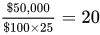
Thus, every dollar invested would yield a benefit of $20.
Why should the ROI of training be calculated?
Training ROI estimates seek to address two related questions:
- Are trainees learning new information and developing new abilities to improve efficiency and/or decrease expenses at work?
- Is there a positive correlation between the expense of training and the advantages it provides to both the organization and the employees?
ROI helps organizations justify the cost of a training course, compare one training course to another, and design training programs. It is a straightforward process for tracking training effectiveness and determining the value addition made by the program.
Businesses must be adaptable to make good use of ROI data. Companies should be open to learning, altering, and experimenting when it comes to training development. ROI calculations can be useful to help organizations minimize the cost and maximize the investment in terms of upskilled employees, low turnover rates, etc.
How do you maximize training ROI?
Now, let’s look at a few ideas to maximize the ROI of training. You will see that each of these suggestions affects different levels of the evaluation model. These measures are simple to put in place and will allow you to analyze the impact of each individual measure at different levels.
1. Determine your company’s requirements
Determine the genuine learning requirements of the business, because the first phase of the design and development process can be initiated only after determining the objective of training. According to the Huffington Post, companies that invest in training achieve up to 24% higher profit margins. Training that aims toward company demands and expectations will allow you to produce an aligned product that meets your targets.
2. Connect to performance objectives
Training that is linked to real-world performance gains is a wise investment. Studies show that 94% of employees stay longer in a company if the company invests in their learning and development. The information in a training program should align with the performance outcomes of an employee, linking them to KPIs and corporate objectives. This method will also aid in determining what defines post-training learner success and in providing a mechanism for measuring the effect and success of the training program.
3. Connect with SMEs
Involve subject matter experts (SMEs) from the beginning of a project to guarantee effective learning. Determine what learners genuinely need to know and utilize appropriate experts to guide training from the start.
4. Create practical content
A learner-centric training approach will benefit both employees and employers. Content that is practical enough to apply on the job has a higher ROI. Research shows that only 12% of employees claim they can use skills acquired through learning in their job. Therefore, companies should focus on producing learning materials that are both relevant and specific to an employee’s day-to-day tasks; such information can be immediately be put to use rather than remaining theoretical.
The investment in any company is measured by its return. When a company invests in a product or an initiative, it expects the earnings to surpass the costs of the investment. Investing in staff training enhances profitability by cutting expenditures and manifesting advantages such as reduced turnover or fewer penalties for noncompliance. Training also contributes to increased revenue in the form of faster sales growth and improved productivity. Implementing the suggestions in this article and approaching training as a project with verifiable, time-bound goals will help you maximize your training return on investment.