Moving from Training Programs to Creating a Culture of Learning

Training and productivity have always been directly correlated. Studies by the American Society for Training and Development show that organizations that prioritize workforce training, allocating budgets and focusing on incremental spending each year, have seen:
- An increase in profit margins of 24%
- An increase in revenue per employee of 218%

While these numbers paint a bright picture, L&D leaders are finding traditional training approaches unsustainable.
Industry experts believe that there are six big issues with traditional or instructor-led training (ILT):
- Lack of flexibility
- Limited focus on application
- “Push” model
- Tendency to become long and boring
- Disregard for individual curiosity when learning
- Loss of productive employee time
These limitations are having a measurable impact on the bottom line for organizations, requiring them to explore new ways of training their workforce.
A sneak peek into industry trends
The 2020 LinkedIn Workplace Learning Report shares some compelling trends that showcase the change from traditional training programs to online learning:
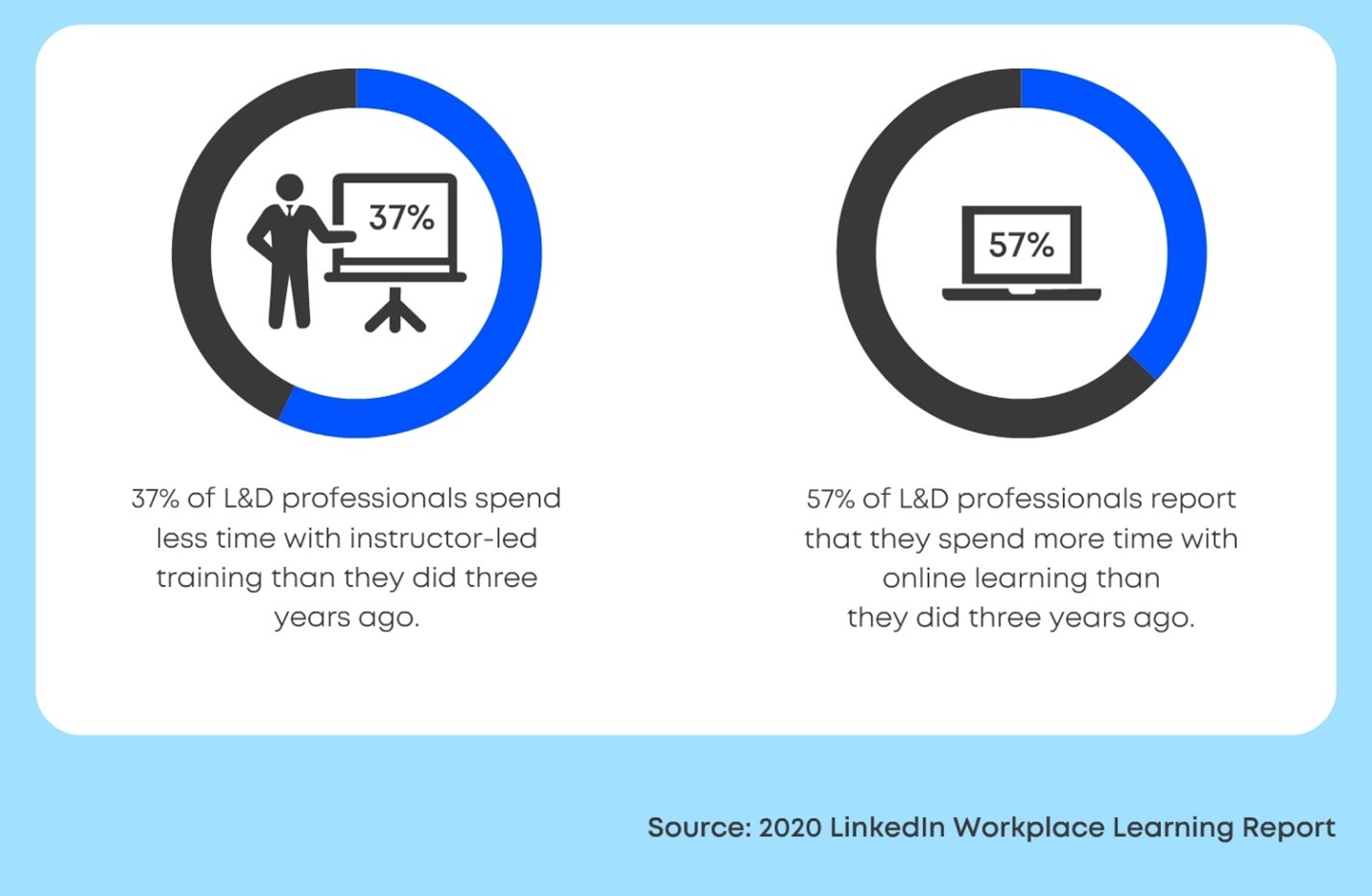
The move toward online learning, accelerated by the pandemic, has had many positive results, but it still isn’t necessarily solving learning challenges such as the lack of intrinsic motivation to learn among employees, the skill gap crisis that employers are talking about, or the continuous learning needs of the dynamic workplace today.
Learning challenges that need to be addressed
- Secondary learning: A McKinsey report found that 90% of the businesses believe they are going to face some sort of skill gap in the coming years, but only 16% of them are equipped to meet and solve for these gaps. The gaps can only be solved by facilitating secondary education, or through ongoing training.
- Intrinsic motivation: No matter how structured and interesting an e-learning course is, unless employees are intrinsically motivated to learn, are learning to acquire a new skill, or are enjoying the process of learning, the course becomes a chore. A study by Workstars shows a strong correlation between intrinsic motivation and learning behaviors.
- Workplace learning needs: By 2025, millennials will be 75% of the workforce. While they believe skill and career development are important, the way they learn, and how and where they learn, are going to be very different, according to a study by Training Industry.
The solution to these problems lies in the way companies approach training. There needs to be a significant shift away from focusing on the consumption of e-learning courses, workshops, and modules and toward building a learning culture.
From a training culture to a learning culture
Building a “culture of learning” means empowering each individual within an organization to take responsibility for their learning journey, and in turn enabling them to learn skills that they believe will help them.
But building a learning culture is easier said than done. Like Matthew Smith, the chief learning officer at McKinsey, said on the McKinsey Podcast: “There is a huge role that organizations play in setting the context and the culture for learning. Like so many things, it starts at the top, and it starts with having a CEO or a senior leader who actually values learning and talks about it very actively.”
To make it easier for you to implement a learning culture within your organization, we have put together the guide “Moving from Training Programs to Creating a Culture of Learning” based on our experience of delivering 10,000+ learning experiences and working with 100+ clients for close to two decades.